As businesses expand, operations naturally become more complex. New clients, additional employees, larger projects, and increasing workloads often expose inefficiencies that were barely noticeable when the organization was smaller.
Without a clear operational structure, teams spend valuable time searching for information, attending unnecessary meetings, duplicating work, or manually tracking progress across multiple systems.
Operational efficiency is about doing more with the resources you already have. It focuses on improving processes, reducing wasted effort, and enabling teams to deliver consistent results without increasing unnecessary complexity.
This guide explores twelve practical strategies that businesses can implement to improve operational efficiency and build a stronger foundation for sustainable growth.
Operational efficiency refers to an organization's ability to deliver high-quality outcomes while making the best possible use of available resources, including people, time, technology, and processes.
An operationally efficient business:
- Completes work on time
- Reduces unnecessary effort
- Minimizes errors
- Improves productivity
- Delivers better customer experiences
- Responds quickly to changing priorities
The goal isn't to make employees work harder—it's to help them work smarter.
Organizations with inefficient operations often experience:
- Repeated manual work
- Delayed approvals
- Poor communication
- Missed deadlines
- Conflicting priorities
- Slow decision-making
- Inconsistent customer experiences
Improving efficiency creates measurable business benefits, including higher productivity, lower operational costs, and better employee satisfaction.
1. Standardize Business Processes
When every employee follows a different process, consistency becomes difficult. Documenting and standardizing workflows ensures that work is completed the same way across teams, reducing errors and improving quality.
Business information scattered across emails, spreadsheets, messaging platforms, and shared drives creates unnecessary delays.
Centralizing projects, tasks, files, and updates provides one reliable source of truth for the entire organization.
Many organizations continue performing repetitive administrative tasks that consume valuable time.
Look for opportunities to simplify routine activities such as:
- Task assignment
- Progress tracking
- Status reporting
- Document organization
- Approval workflows
Reducing manual work allows employees to focus on higher-value activities.
Managers should never have to guess:
- Which projects are behind schedule
- Which employees are overloaded
- Which tasks require attention
Operational visibility enables faster decisions and proactive problem-solving.
Not every task contributes equally to business success.
Evaluate work based on:
- Customer impact
- Revenue contribution
- Operational importance
- Project dependencies
Focusing on high-value activities improves overall business performance.
Many meetings exist simply because project information isn't easily accessible.
Providing real-time project updates and activity tracking allows meetings to focus on decisions rather than status reporting.
Operational improvement requires measurable data.
Track indicators such as:
- Project completion rates
- Task completion times
- Resource utilization
- Client response times
- Operational bottlenecks
KPIs help managers identify improvement opportunities before problems become critical.
Overloading a few employees while others remain underutilized reduces efficiency.
Review workload distribution regularly to ensure resources are used effectively and employee burnout is minimized.
Operational excellence isn't achieved through one major change.
Encourage employees to identify small improvements regularly.
Even minor process adjustments can generate significant long-term gains.
Sales, operations, finance, marketing, and customer support often depend on one another.
Improving coordination between departments reduces delays, improves information flow, and strengthens customer service.
Operational decisions should rely on measurable information rather than assumptions.
Regular reporting helps leaders identify:
- Trends
- Risks
- Performance gaps
- Growth opportunities
Better data leads to better decisions.
As organizations grow, spreadsheets and disconnected tools become difficult to maintain.
Operations management software centralizes:
- Projects
- Tasks
- Teams
- Clients
- Documents
- Calendars
- Reports
- Activity updates
One connected platform improves efficiency across the entire organization.
Many organizations unintentionally reduce efficiency by:
- Using too many disconnected tools
- Relying on manual processes
- Failing to measure performance
- Ignoring workload imbalances
- Creating inconsistent workflows
- Delaying operational improvements
Recognizing these issues is the first step toward building a more efficient organization.
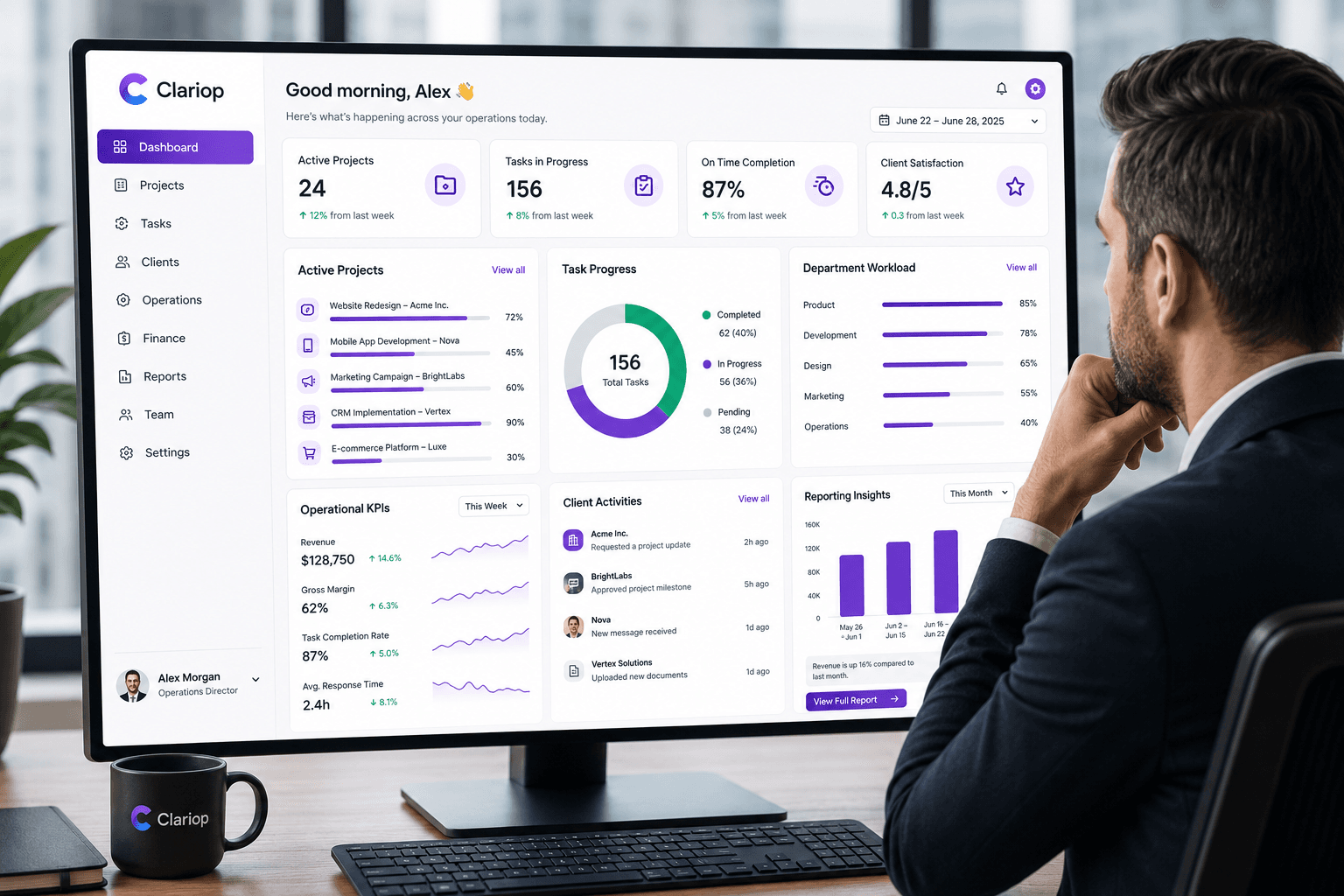
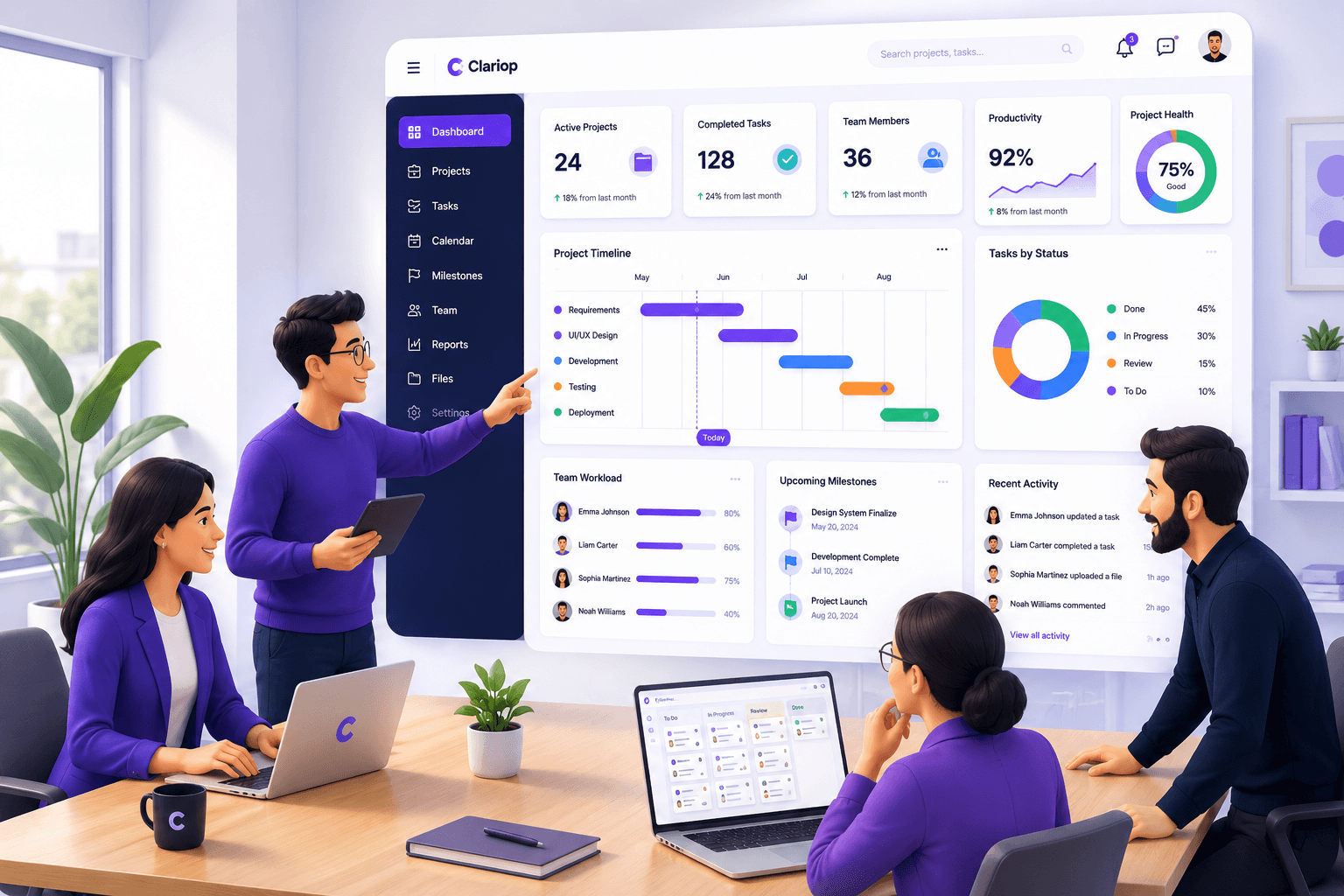
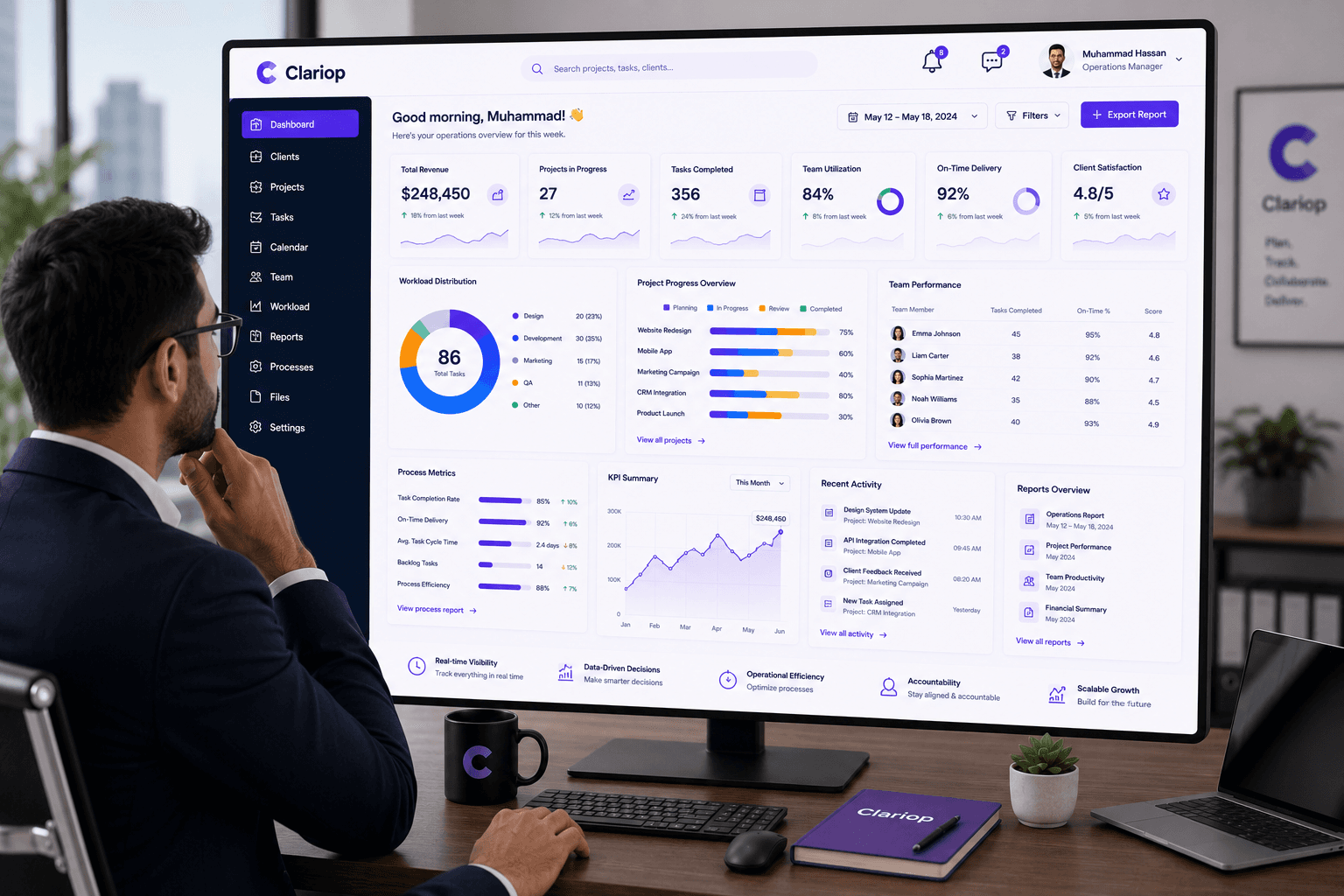
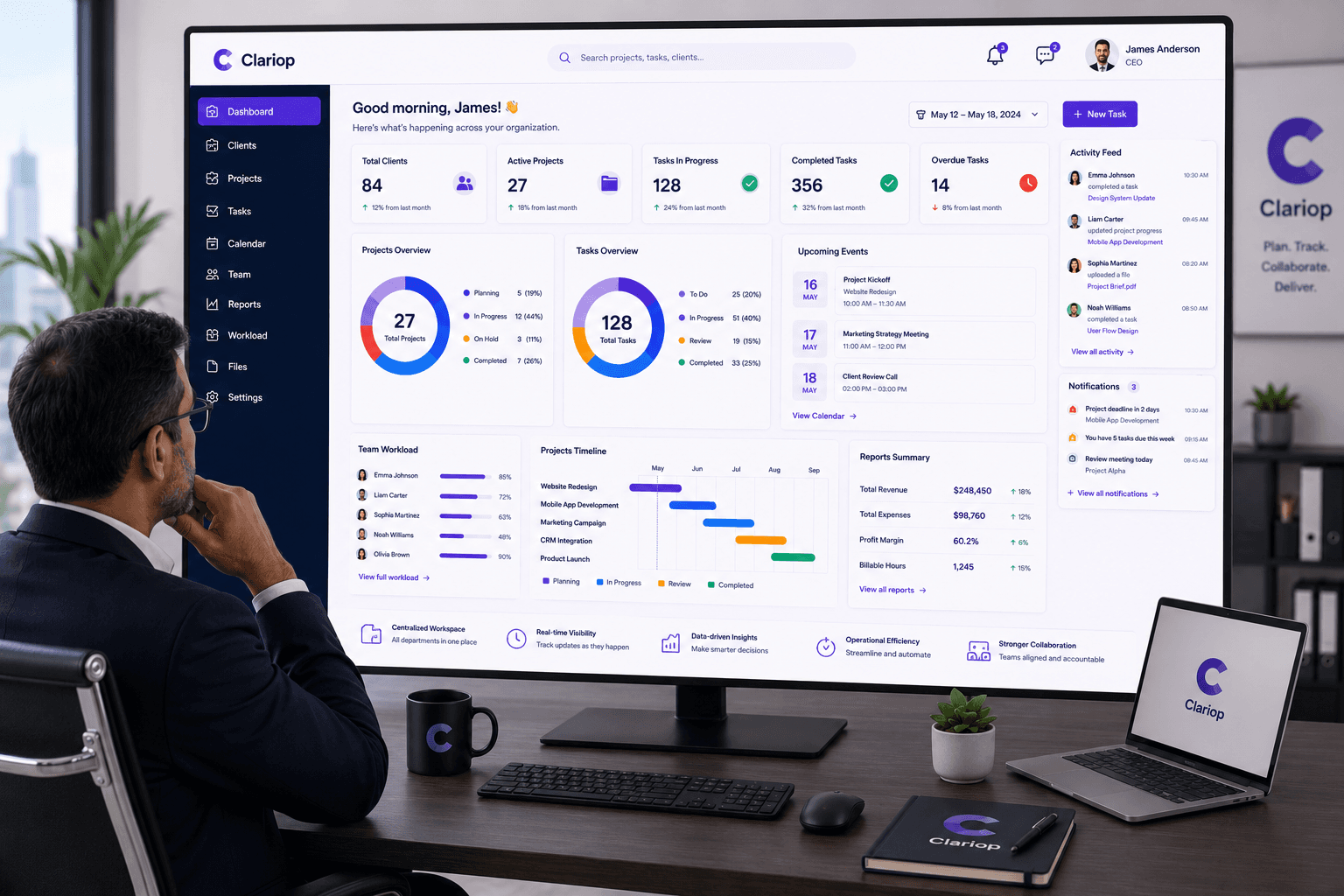
Clariop helps organizations simplify daily operations by bringing projects, tasks, teams, documents, calendars, reports, and activity updates into one centralized platform.
Instead of switching between multiple applications, businesses gain complete visibility into ongoing work, helping managers identify bottlenecks, improve accountability, and make faster operational decisions.
By reducing complexity and improving organization, Clariop enables teams to focus on delivering value rather than managing scattered information.
Operational efficiency is one of the most valuable competitive advantages a business can develop.
Organizations that streamline processes, improve visibility, eliminate unnecessary work, and invest in structured operations are better positioned to scale, adapt, and consistently deliver outstanding results.
Improving efficiency isn't about doing more work—it's about creating better systems that allow your people to perform at their best.
What is operational efficiency?
Operational efficiency is the ability to deliver high-quality business outcomes while making the best possible use of available resources.
Why is operational efficiency important?
It improves productivity, reduces waste, strengthens decision-making, lowers operational costs, and enhances customer satisfaction.
How can businesses improve operational efficiency?
By standardizing processes, centralizing information, improving visibility, monitoring KPIs, balancing workloads, and adopting operations management software.
Can operations management software improve efficiency?
Yes. It provides one centralized platform for managing projects, tasks, teams, documents, reporting, and operational workflows, reducing manual effort and improving visibility.
Growth shouldn't create operational chaos. With Clariop, you can organize projects, manage tasks, coordinate teams, monitor progress, and improve operational visibility—all from one centralized platform. Start your 30-day free trial today and build a more efficient business.

 Priya Nair