Running a successful business requires much more than completing projects on time. Sustainable growth depends on how effectively an organization manages its daily operations, coordinates teams, standardizes processes, and responds to changing business demands.
Many companies experience operational challenges not because employees lack skill, but because workflows become increasingly difficult to manage as the business expands.
By adopting proven operations management best practices, organizations can improve productivity, reduce operational waste, strengthen accountability, and create systems that support long-term growth.
In this guide, we'll explore ten practical best practices that help businesses build more efficient and scalable operations.
Operations management connects every part of a business.
From project planning and task execution to client delivery and reporting, operational processes determine how efficiently work moves through the organization.
Without standardized practices, businesses often experience:
- Inconsistent workflows
- Delayed decision-making
- Limited operational visibility
- Resource conflicts
- Repeated manual work
- Lower customer satisfaction
Strong operational practices create consistency and help organizations perform at a higher level.
1. Build Standard Operating Procedures (SOPs)
Consistency begins with documented processes.
Create Standard Operating Procedures (SOPs) for recurring business activities such as:
- Client onboarding
- Project setup
- Task assignment
- Document approvals
- Project closure
Documented processes reduce errors and make onboarding new employees much easier.
Information should never be scattered across multiple tools.
Projects, tasks, files, calendars, reports, and activity updates should be managed from one centralized platform where everyone has access to the latest information.
A single source of truth improves visibility and reduces unnecessary delays.
Every responsibility should have one accountable owner.
Whether it's a project, task, client request, or approval, assigning clear ownership eliminates confusion and increases accountability across the organization.
Operations should be reviewed regularly—not only when problems occur.
Track:
- Project progress
- Task completion
- Team workload
- Client commitments
- Upcoming deadlines
- Operational risks
Continuous monitoring allows managers to identify issues before they affect business performance.
Departments rarely operate independently.
Sales, operations, finance, marketing, and customer support depend on one another to deliver successful outcomes.
Encouraging visibility across departments improves communication and reduces operational bottlenecks.
Operational improvement requires measurable data.
Monitor indicators such as:
- Project completion rate
- Task completion time
- Average response time
- Team utilization
- Client satisfaction
- Workflow efficiency
KPIs provide valuable insights for continuous improvement.
Transparent operations create trust.
When employees understand project priorities, workload, deadlines, and recent activity, they make better decisions and collaborate more effectively.
Visibility also reduces unnecessary meetings and follow-up requests.
8. Review and Improve Processes Regularly
Business processes should evolve alongside the organization.
Schedule periodic reviews to identify:
- Bottlenecks
- Repetitive work
- Approval delays
- Resource constraints
- Opportunities for automation
Small improvements made consistently often produce significant long-term results.
Processes that work for ten employees may not work for one hundred.
Design operational workflows that can scale with business growth by using standardized templates, centralized systems, and structured reporting.
Scalable processes reduce disruption as the organization expands.
Modern businesses need more than spreadsheets.
Operations management software enables organizations to:
- Manage projects
- Organize tasks
- Coordinate teams
- Track progress
- Store documents
- Monitor activity
- Generate reports
- Improve operational visibility
Centralized software provides leaders with better control over business operations while reducing administrative complexity.
Organizations often limit operational performance by:
- Using disconnected systems
- Failing to document processes
- Ignoring operational metrics
- Assigning unclear responsibilities
- Reacting to problems instead of preventing them
- Delaying process improvements
Avoiding these mistakes helps businesses build stronger operational foundations.
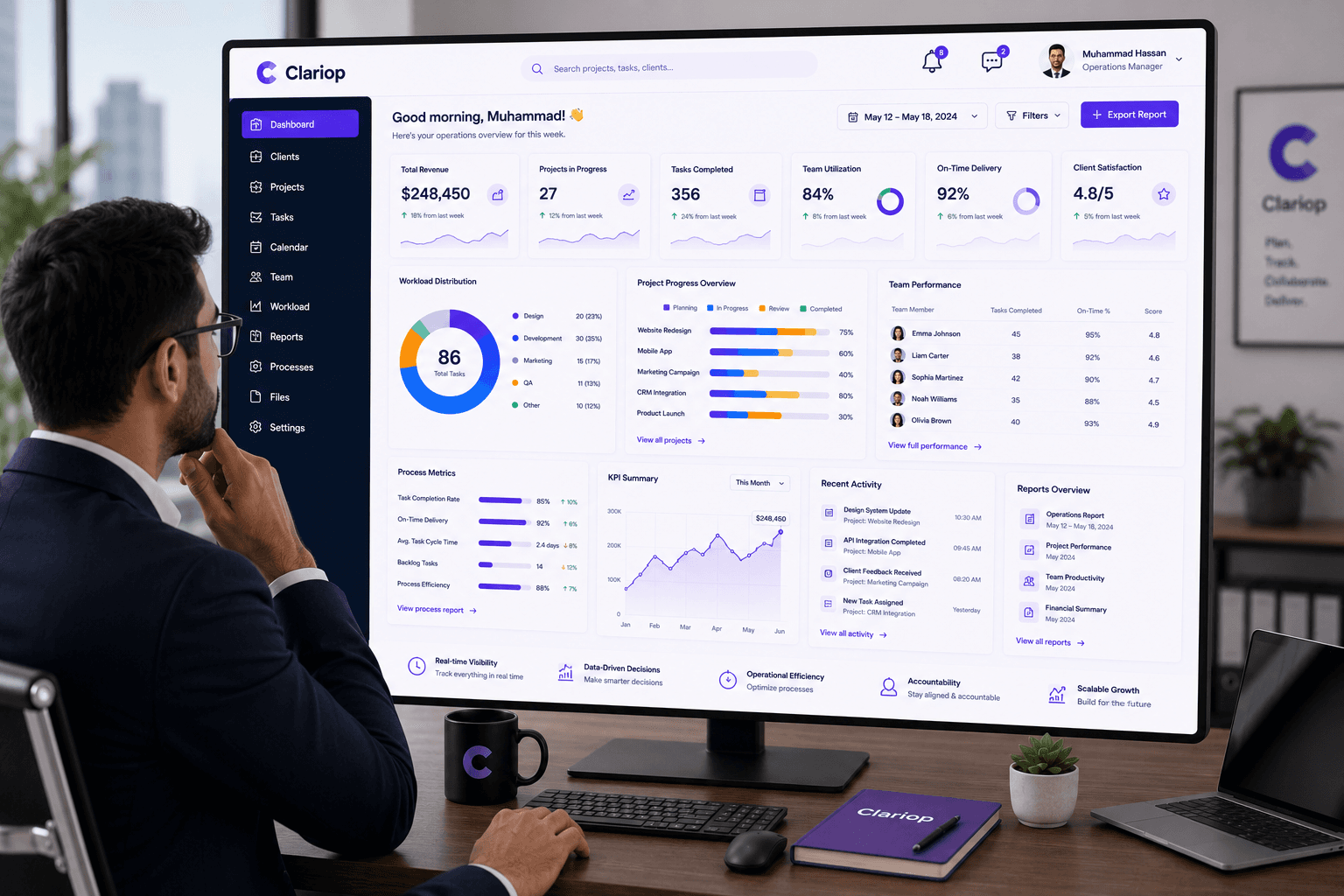
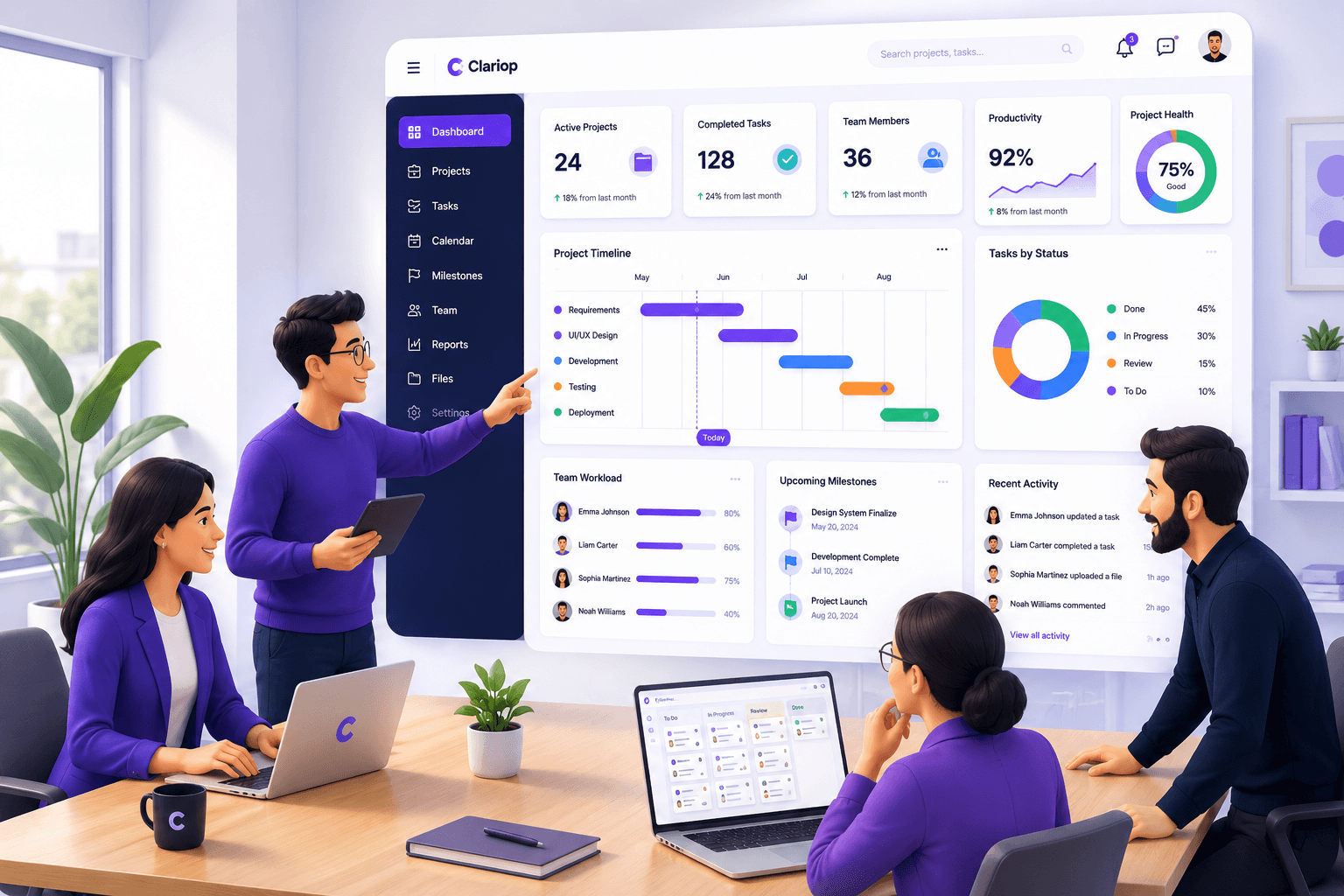
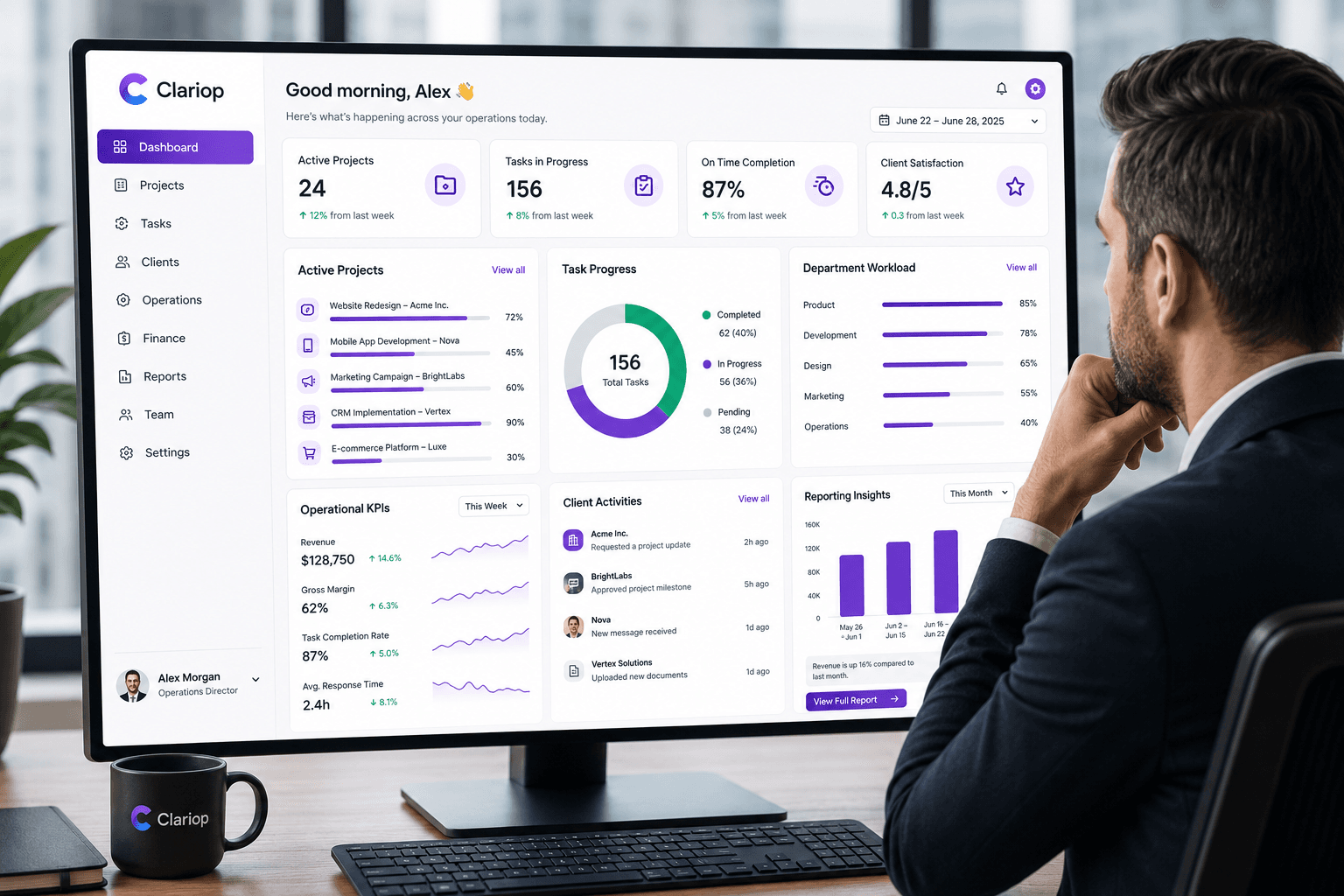
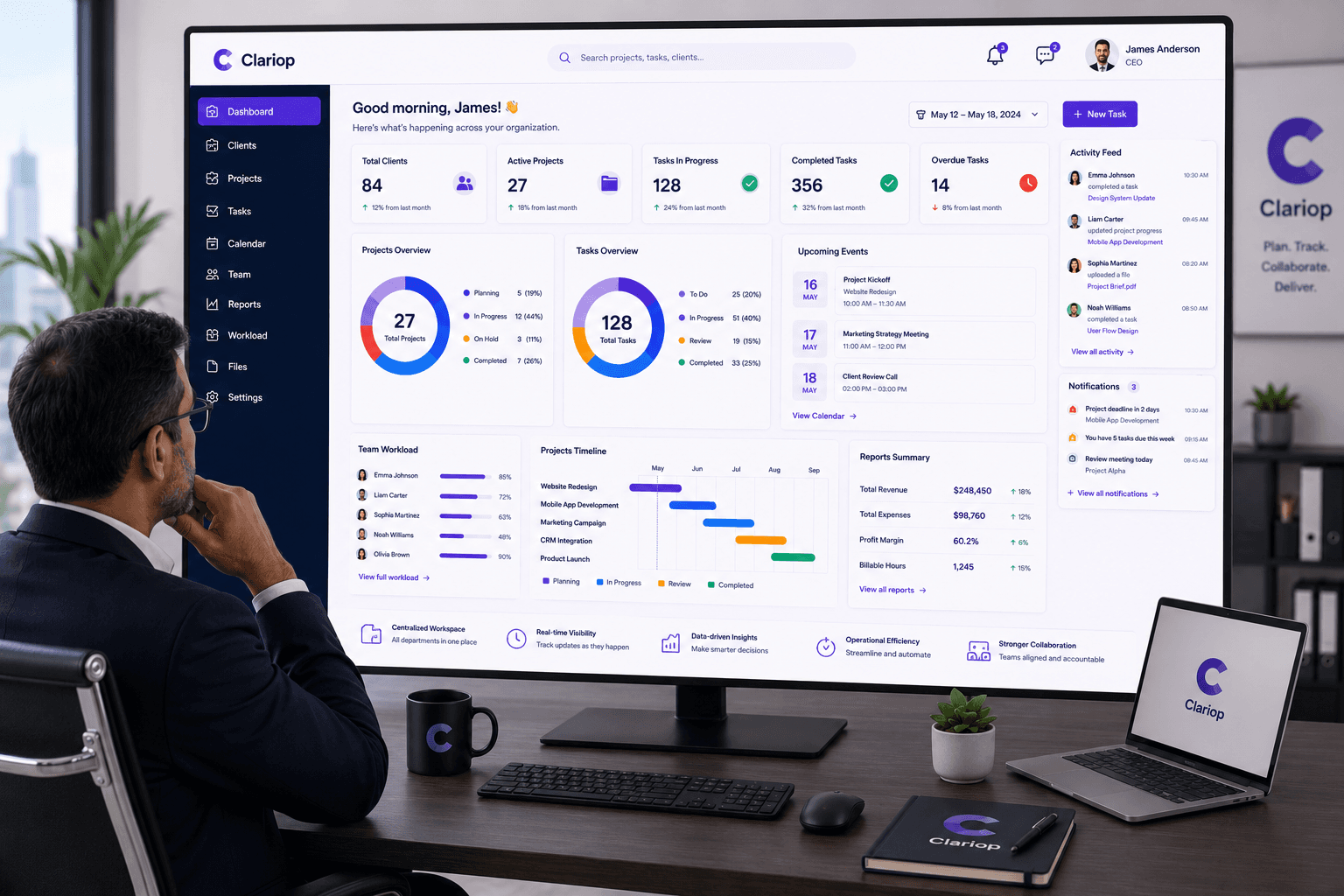
Clariop is designed to simplify operations management by bringing together projects, tasks, teams, clients, calendars, documents, reports, and activity updates into one unified workspace.
Managers gain complete operational visibility while employees benefit from clear responsibilities, structured workflows, and real-time progress tracking.
Instead of managing work through multiple disconnected applications, Clariop helps organizations streamline operations and improve productivity across every department.
Operational excellence is not achieved through one major initiative—it is built through consistent, well-managed processes.
Organizations that standardize workflows, improve visibility, measure performance, and continuously refine operations create stronger teams, happier customers, and more sustainable growth.
As businesses become more complex, investing in structured operations management becomes a strategic advantage rather than simply an operational improvement.
What are operations management best practices?
Operations management best practices are proven methods that help businesses organize workflows, improve efficiency, strengthen accountability, and support long-term growth.
Why are Standard Operating Procedures important?
SOPs create consistency, reduce errors, simplify training, and ensure that recurring work is completed using the same proven process.
How often should operational processes be reviewed?
Most organizations benefit from reviewing operational processes quarterly or whenever significant business changes occur.
Can operations management software improve scalability?
Yes. It centralizes projects, tasks, reporting, and operational data, making it easier for businesses to grow without increasing unnecessary complexity.
Operational excellence begins with organized systems and complete visibility. With Clariop, you can manage projects, tasks, teams, clients, documents, calendars, and reports from one centralized platform designed to help your business scale efficiently. Start your 30-day free trial today and take the next step toward operational excellence.

 Priya Nair